
Fentress Release Dates Defined
Four dates often appear in sentence and release records, and each answers a different question. The sentence imposed comes from the judgment. Sentence expiration is the calculated legal end of the term. A Release Eligibility Date, often called RED, marks the point when the governing law permits parole consideration. A projected release date is an administrative estimate based on the sentence, jail credit, applicable percentage, credits, and current status.
None of those future dates is the same as an actual release. The actual event exists only after the holding agency records that custody ended. Even then, the destination matters. A person can leave the Fentress County Jail for TDOC, another county, federal custody, or immigration custody without returning to the community.
| Date or term | What it means | What it does not prove |
|---|---|---|
| Sentence imposed | The court’s term in the judgment | The day physical custody will end |
| Sentence expiration | The calculated legal end of a sentence | Whether an earlier conditional release will occur |
| Release Eligibility Date | The first point when parole may be considered under the governing law | That parole will be granted |
| Projected release date | A current administrative estimate using the applicable calculation | A guaranteed departure time |
| Actual release | The custodian’s completed release transaction | That no other agency received custody |
Match the Fentress Release System
The search route depends on where the person is held. A pretrial Fentress County detainee does not have a sentence-based projected release date. Bond may permit release, but the court’s bond action can precede jail processing, and an outside hold can prevent a community departure. Ask the Fentress County Circuit Court Clerk for the bond order or docket event, then ask the jail for the actual release transaction.
A person serving a county sentence needs the local judgment and jail computation. The clerk can supply the sentence length and credit ordered. The sheriff’s custody record can show the computed discharge and completed release. TDOC’s felony calculation should not be imported into a local misdemeanor stay.
For a state sentence, use Tennessee Department of Correction records. A person sentenced in Fentress County may be placed anywhere in the state system because no TDOC prison was identified within the county. Federal and ICE cases use separate systems, and a BOP future date has its own federal meaning.
Note: A missing name on a current list cannot supply a projected or actual date and may instead reflect a transfer.
Find Fentress Projected Release Dates
TDOC Felony Offender Information Lookup, or FOIL, is the official public starting point for a state felony offender. It covers people currently or formerly in TDOC custody or supervision. Search modes include name, TDOC ID, and State ID. A name search provides last and first name fields, race, and an alias option. The user must also complete a case-sensitive CAPTCHA.
The screenshot below comes from the official FOIL search and shows the fields that begin a Tennessee sentence or release lookup.
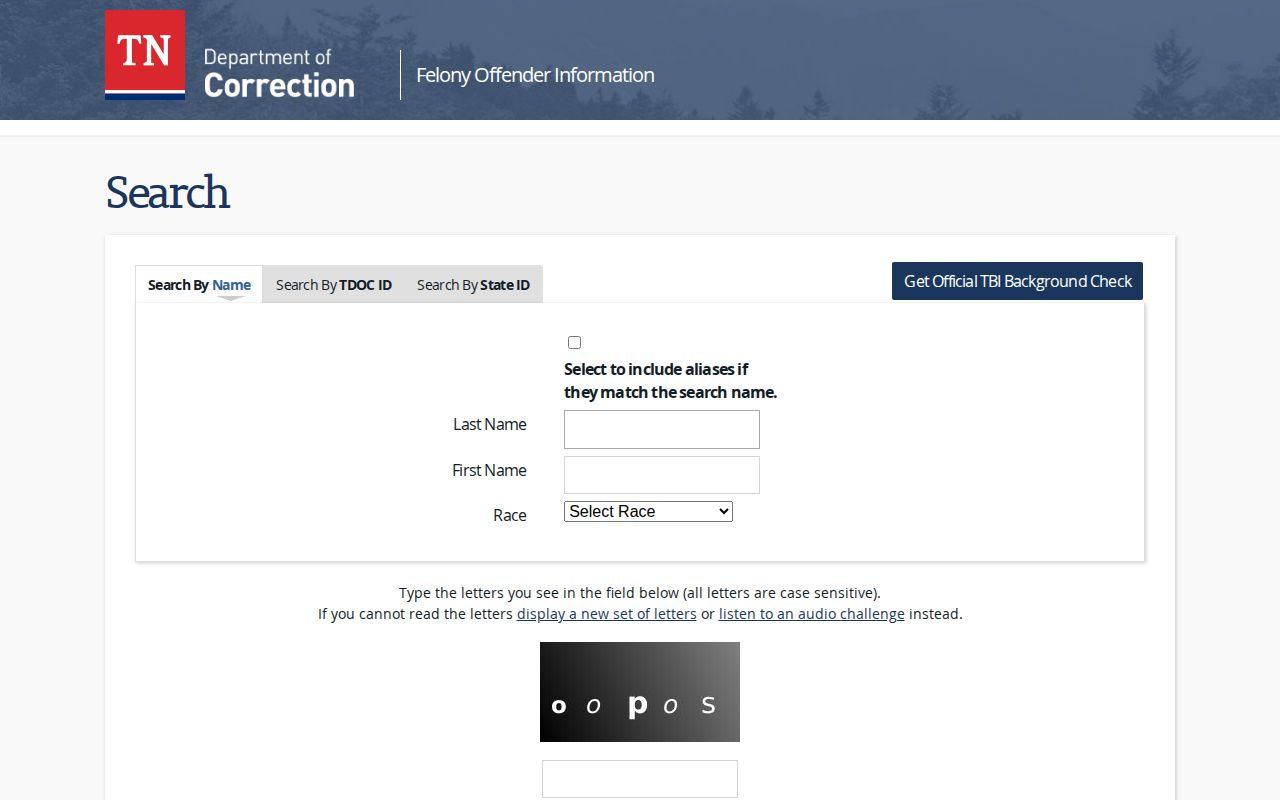
The search form alone does not give a date. Open the correct detail only after comparing identifiers, then copy the exact field label and date shown.
FOIL status also changes how a future date should be read. Incarcerated status points to continuing physical custody. Parole or probation describes community supervision, while inactive can indicate that active TDOC custody or supervision ended. None of those labels should be replaced with a guessed release date. The public detail used for research was not populated with a named person, so no exact Tennessee field label was invented. Preserve the label displayed on the lawful live record, then distinguish release eligibility, sentence expiration, a projected date, and a completed release event.
- Identify whether the person is pretrial, serving a county sentence, in TDOC custody, or held by another system.
- For TDOC, search FOIL by ID when possible, or use name and compare all available identity details.
- Read status, location, sentence information, parole-hearing status, and release information together.
- For a county sentence, obtain the judgment from the clerk and the jail’s current computation from the sheriff.
- Confirm a completed release through the custodian’s release transaction and ask whether another agency received custody.
The broader Fentress County released inmate record path covers how to pair a jail transaction with the court disposition when the event has already occurred.
Fentress Release Eligibility Is Conditional
TDOC calculates the Release Eligibility Date. The Tennessee Board of Parole decides whether parole is granted. Those are separate acts. A hearing may be denied or deferred, and a grant can depend on required votes, an approved release plan, or other conditions. The Board can also rescind action before release in the circumstances recognized by its process.
The Board of Parole information explains the RED and decision process captured below.
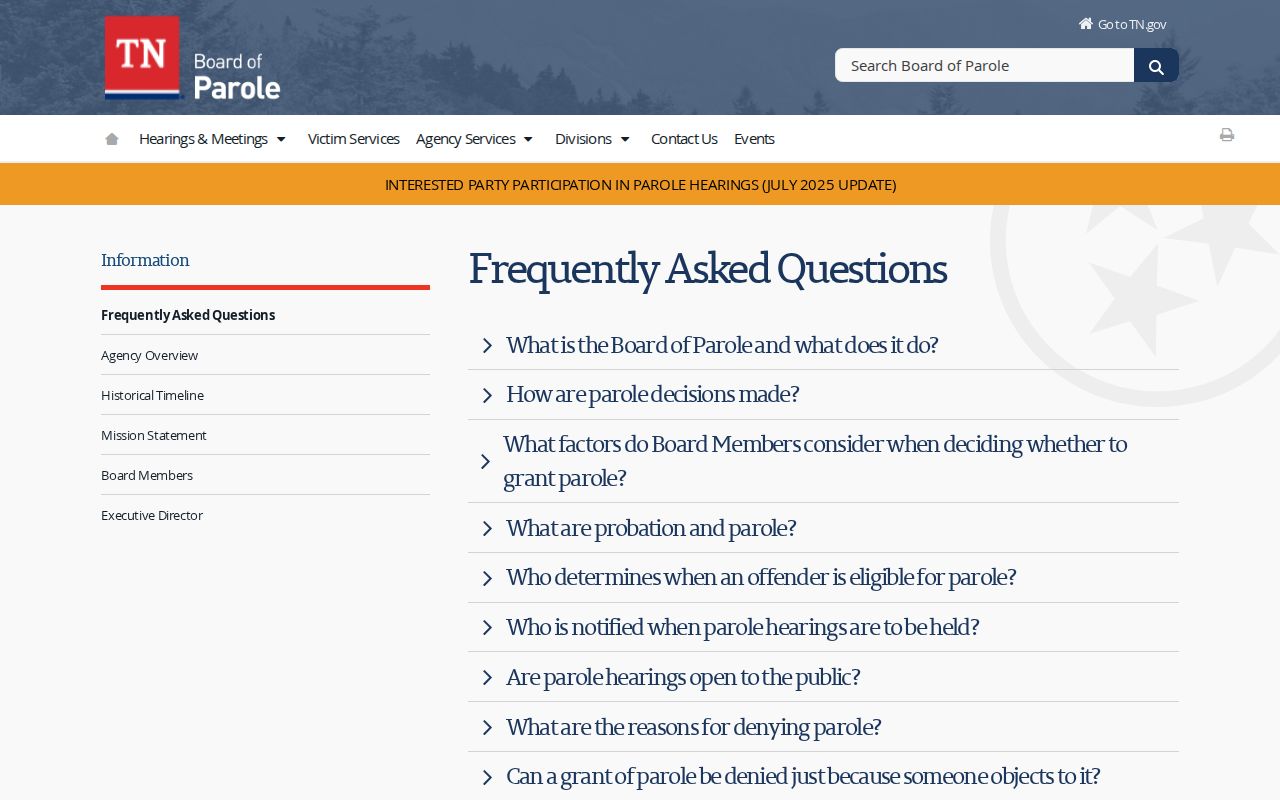
This official source supports a key distinction: parole eligibility is permission for consideration, not a promise that release will occur on that date.
T.C.A. § 40-35-501 governs release eligibility and must be applied using the offense, offense date, conviction, and relevant subsection. A hearing calendar only establishes that a hearing is scheduled. For a person-specific answer, the judgment, TDOC calculation, and any final Board action must be read together.
Fentress Release Credits and Percentages
Tennessee does not use one release percentage for every sentence. T.C.A. § 40-35-501 contains multiple rules and offense-specific limits. Under subsection (i), specified violent offenses require service of 100 percent less allowable credits, and those credits cannot reduce the sentence by more than 15 percent. That is why the rule is often shortened to “85 percent,” but the shorthand applies only to governed offenses and facts.
Public Chapter 988, the 2022 Truth in Sentencing Act, added offense-specific 100-percent and 85-percent treatment for offenses committed on or after July 1, 2022. Its provisions must not be blended with older subsections. Two convictions with different offense dates can follow different rules even if a casual description sounds similar.
T.C.A. § 41-21-236 authorizes sentence-reduction and program credits under TDOC rules. Credits affect a calculation only when the sentencing statute permits them. The judgment’s offense date, exact conviction, sentence structure, and applicable code section are needed before any percentage can be used.
Why Fentress Release Dates Change
A displayed projected date reflects the information and law applied at that point. Later events can move it or change what the date signifies. A correction does not always mean the prior record was careless. New credit information, discipline, a court ruling, or another agency’s hold can alter the legal and administrative calculation.
| Factor | Possible effect | Record to check |
|---|---|---|
| Sentence or program credits | May advance a date where the statute allows | TDOC calculation and credit record |
| Disciplinary loss or restoration | May move a date later or restore an earlier calculation | TDOC sentence records |
| Jail-credit correction | Changes credited time already served | Judgment, amended order, and computation |
| Concurrent or consecutive terms | Changes how multiple sentences combine | Judgments and TDOC sentence detail |
| Appeal or later court order | Can alter a conviction, term, or credit | Court docket and signed order |
| Detainer or hold | May block community release or cause transfer | Release transaction and receiving-agency record |
| Parole decision or plan | Eligibility may not become physical release | Board action and TDOC status |
Revocation, escape time, clerical corrections, and plan approval can also matter. The exact effect is case-specific. Keep the field label with the date because sentence expiration, RED, projected release, and actual release cannot be used interchangeably.
Fentress Jail Weekend Release Dates
No official Fentress County jail good-time policy or weekend-advance release rule was found in the reviewed sources. A calendar date that lands on a weekend therefore does not support a promise of Friday release. The local calculation belongs with the jail, based on the judgment and any credit the court ordered.
Call the Fentress County Jail at 931-879-8142 and ask a narrow question about the existing computation or completed transaction. The published lobby is open 8 a.m. to 4 p.m. Monday through Friday except federal holidays, but those lobby hours are not release-processing hours. If staff cannot provide the record by phone, use the county inspection or copy process.
The Fentress County Circuit Court Clerk at the Justice Center holds the judgment, sentencing order, and docket events. The sheriff record then shows whether and when jail processing ended. Neither office should be asked to create a projection that its records do not contain.
Note: Published lobby hours describe public access to the office, not the time a sentenced person will leave custody.
Confirm Fentress Actual Release
A projected date should be checked again near the expected event. For TDOC custody, review FOIL for the newest status and release information. Tennessee VINE can provide prospective custody-change notice for a matched person, but an alert is not a certified release certificate. Its reporting agency must still be identified.
For the Fentress jail, ask for the booking and release record with the release date and time, authority or type, and receiving agency or destination. If the record names TDOC, another county, USMS, or ICE, continue with that custodian. The county jail stay ended, but community release was not proved.
The local court and jail records should be read as a pair. The clerk maintains General Sessions and Criminal case records that can contain a judgment, sentence, bond order, dismissal, or later order. The sheriff controls the custody transaction. A signed order is authoritative about the court's action, but paperwork, a warrant, transportation, or another hold can still stand between that action and physical release. For an exact time, the jail event remains essential.
Keep a short evidence log when a date matters. Record the agency, full URL, retrieval time, identifier, exact field label, and status. If FOIL later changes, that record helps explain whether the date moved or the person entered a new status. When two official sources conflict, ask the agency that physically holds the person to reconcile the event instead of choosing the earlier date. That keeps the court order, projected date, and completed event distinct.