
Fentress Parole and Probation Compared
Parole and probation both permit a person to live in the community under rules, yet they begin in different ways. The Tennessee Board of Parole decides parole matters. Tennessee Department of Correction Community Supervision manages field supervision for parole and state felony probation. A Fentress County court orders probation as a sentence. A person who bonded out or finished a misdemeanor jail term may have neither status.
These labels must be read as legal status, not as a broad synonym for release. Parole continues a prison sentence under conditions before sentence expiration. Probation is a court sentence served in the community, though a split sentence can include jail time first. TDOC also identifies determinate release and mandatory reentry supervision as distinct release types. The source record should control the wording.
| Point | Parole | Probation |
|---|---|---|
| How it begins | Board action permits conditional release before sentence expiration | A court orders a community sentence, sometimes after split confinement |
| Who supervises | TDOC Community Supervision | TDOC for state felony cases, or the office named by the court |
| Public verification | FOIL status, release details, and District 21 when appropriate | FOIL for covered state cases plus the judgment and supervising office |
| How it ends | Discharge, sentence expiration, or another recorded Board/TDOC action | Completion or discharge under the sentencing court and supervising authority |
- Parole
- Conditional community release before the underlying prison sentence expires.
- Probation
- A community sentence ordered by a court instead of, or after part of, confinement.
- Discharge
- The recorded end of custody or supervision, not just a move from prison to the community.
- Absconder
- A supervised person alleged to have stopped reporting or left supervision without authorization.
Check Fentress Post-Release Supervision
The official public starting point is TDOC Felony Offender Information Lookup, known as FOIL. It covers people currently or formerly in TDOC custody or supervision. Search by a name, TDOC ID, or State ID. A name search offers first name, race, and an aliases option, while the page requires a case-sensitive CAPTCHA. Match more than the name because two people can share one.
A FOIL label of parole or probation points to community supervision, not incarceration. An inactive status requires more review. It can be a lead that active TDOC custody or supervision ended, but the sentence and release information must be read before calling it a discharge. The county jail does not have a public historical release portal, and a local booking may never appear in FOIL if it was outside the state felony system.
- Collect the full legal name and TDOC or State ID when legitimately known.
- Search FOIL and compare identifiers, status, location, offenses, sentence details, and release information.
- Read the exact status. Do not translate parole, probation, inactive, or incarcerated into another term.
- Use the Fentress judgment or docket to confirm what the court ordered when probation is involved.
- Contact TDOC District 21 with the TDOC ID when a current serving-office fact must be confirmed.
A complete release search may also require the original jail transaction. The Fentress County released inmate search path explains how the sheriff record and court disposition work together.
Fentress Supervision Uses District 21
TDOC Community Supervision District 21 serves Fentress County. The published office for Fentress, Anderson, Morgan, and Scott Counties is in Clinton, not Jamestown. That location matters when a FOIL record shows parole or probation and an official field-office contact is needed. It should not be confused with the probation offices housed at the Fentress County Justice Center, which may relate to court-managed cases.
The TDOC field office directory documents the district coverage and contact. The directory image below shows the official statewide route used to locate the serving office.
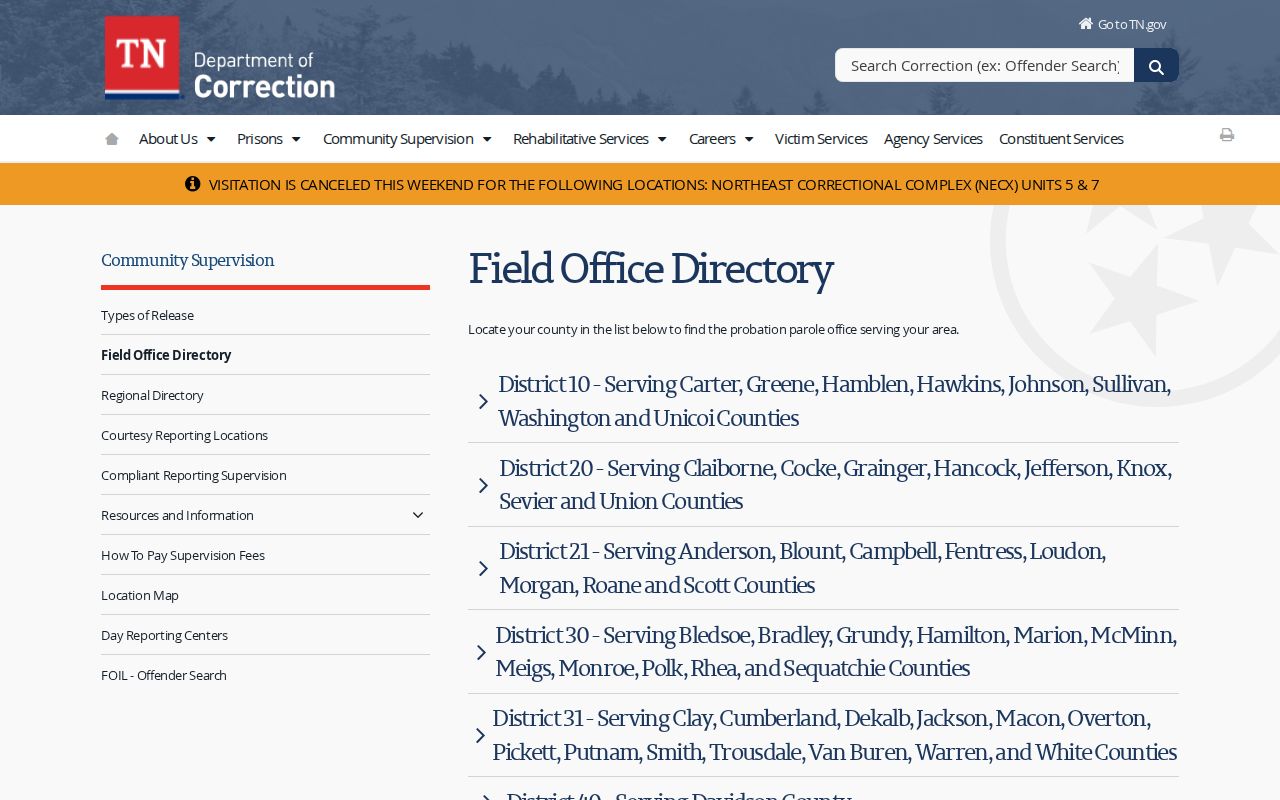
This listing is the right source for office coverage, while FOIL remains the person-specific public status source.
TDOC District 21 Community Supervision
110 E. Centre Stage Business Park
Clinton, TN 37716
Phone: 865-220-4001
Fax: 865-463-7084
Reporting instructions are personal and can change. TDOC announced mobile community-supervision offices for rural areas in 2026, but the announcement gave no fixed Fentress schedule. A person under supervision should follow directions from the assigned officer and confirm any mobile-office date rather than assume a stop will be available.
Note: The Clinton address is a supervision office, not a jail and not proof that a person is physically present there.
Fentress Release Supervision Types
The TDOC release-type descriptions separate several forms of community status. Parole follows Board approval before sentence expiration. Probation follows a court order. Determinate release applies through a statutory process to certain one-to-two-year felony sentences, with TDOC stating that qualifying offenders must have served at least 30 percent and remain subject to the governing process and objections.
Mandatory reentry supervision is another defined status for specified felony sentences and offense dates, including provisions associated with T.C.A. § 40-35-506 for covered offenses on or after July 1, 2021. These details matter because “released” does not always mean all state control ended. The correct record may show a move from prison custody to supervised community status. A later inactive or discharge entry addresses whether that state supervision ended.
Bond is different. It allows release from the Fentress County Jail while a case continues, subject to the court’s terms, but it is not a TDOC parole category. The end of a local sentence also does not prove that TDOC supervision began.
Fentress Warrants and Absconder Checks
No public Fentress County absconder list was found. A supervision violation can lead to a warrant or revocation process, but lack of an online result does not establish that no issue exists. FOIL, TDOC Community Supervision, the Board, and the court each answer different parts of the question. An absconder allegation concerns compliance with supervision; it is not the same as a new conviction.
The Fentress County Sheriff’s Department states that warrant, summons, and civil-paper information is not given by telephone. Its published procedure describes an in-person self-inquiry by a person asking about their own status. Therefore, a refused phone answer cannot be read as a clean warrant check. A caller also should not ask jail staff to interpret a supervision record that belongs to TDOC or the court.
For a suspected parole issue, identify the person in FOIL and contact the assigned supervision channel. For probation, use the judgment to learn which office has authority. If a Board revocation matter exists, obtain the proper notice or record instead of inferring an outcome from missed contact.
Fentress Parole Hearing Records
A parole hearing date is not a release date. The Tennessee Board of Parole publishes that prison and county-jail schedules are updated weekly on Monday, or Tuesday after a Monday holiday. Schedules are supplied by email request at BD.HearingSchedules@tn.gov, and last-minute changes may occur. The Parole Hearings Division can be reached through the Board’s main number, 615-741-1150.
The Board’s parole-hearing information describes the process and schedule route shown below.
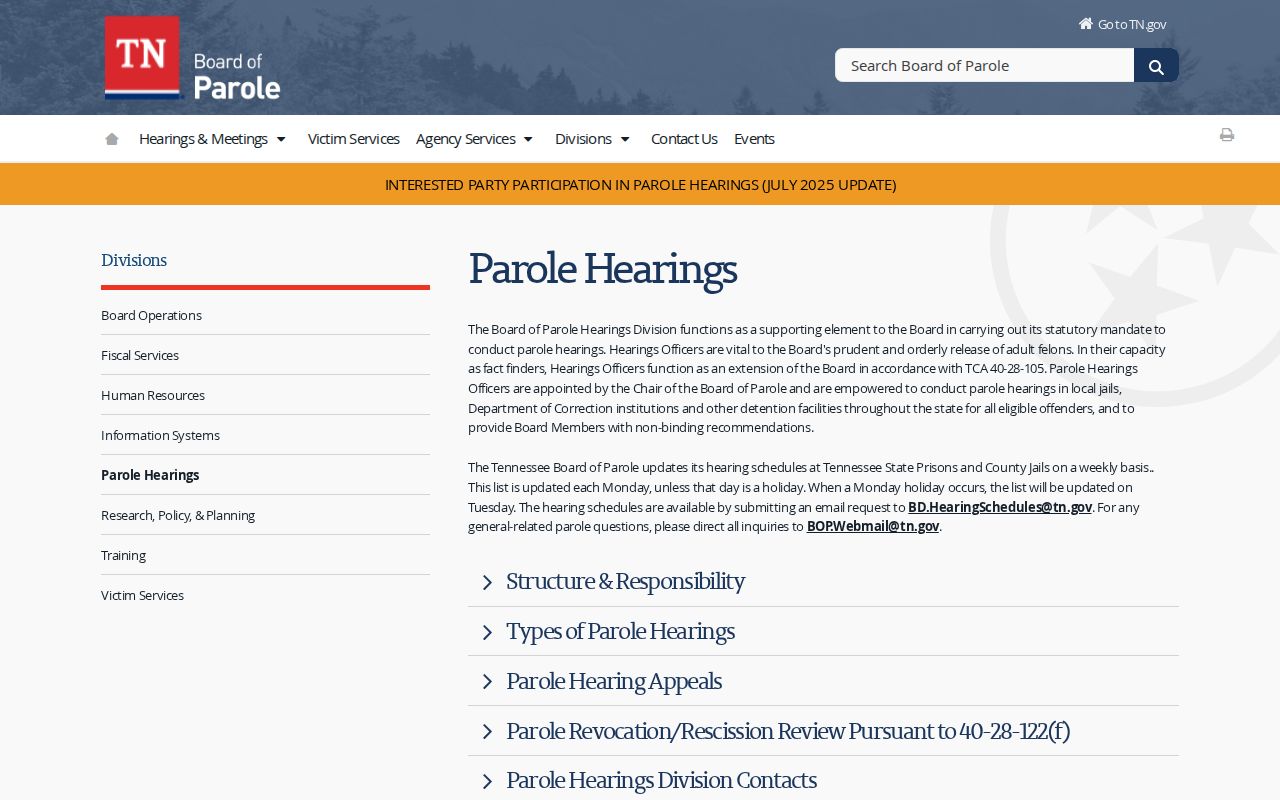
The schedule proves only that a hearing is planned. It does not show that the Board granted parole or that the person left custody. No statewide public decision-results search was found. An offender-specific final notice or releasable status record can be sought through the Board public-records request process, which requires a specific request and proof of Tennessee citizenship.
Hearing officers gather facts and make nonbinding recommendations under T.C.A. § 40-28-105(d)(2). Board members may adopt, change, or reject a recommendation. A grant can still depend on required votes, plan approval, and the absence of rescission. Revocation hearings may result in revocation or reinstatement, while other hearing types address rescission, time setting, or appeals.
Fentress Supervision Conditions and Changes
Conditions are the enforceable rules tied to parole or probation. The controlling order and instructions supply the actual terms. Common supervision functions can include reporting, approved residence or travel, program participation, and compliance with court or Board directions, but no condition should be assigned to a specific person without the record.
A claimed violation does not by itself explain the current status. TDOC may investigate, a warrant may issue through the proper authority, and a hearing or court process may follow. VINE can provide notice of some custody changes, but it is not a public absconder database and cannot replace the supervision record. For a durable result, keep the exact agency, identifier, status label, and retrieval date.
Note: A supervision change may occur after a release, so the newest official status should be checked against the underlying order.
Confirm Fentress Supervision Discharge
Discharge is the formal end of the relevant custody or supervision status. It should not be inferred from a missed appointment, an old address, or a person’s absence from the jail. In FOIL, inactive status is a lead, not a full account. Read the release and sentence details, then request the official TDOC or court record if the exact end date and authority are needed.
For parole, the Board and TDOC records can establish the decision and supervision history. For probation, the sentencing court’s docket or order may show completion, revocation, or discharge. The Fentress County Circuit Court Clerk maintains Criminal and General Sessions records as well as Circuit and Juvenile records, though juvenile access is restricted. Ask for an existing order or docket entry rather than a legal conclusion.
Keep custody and supervision separate. Release from prison can begin parole. Completion of parole can later produce discharge. Each is its own recorded event, with its own date and custodian.