
Federal Release Paths Near Fentress
No Bureau of Prisons institution was identified in Fentress County. Federal custody can still touch a local case. The U.S. Marshals Service may hold a person from court-ordered detention through acquittal or conviction and delivery to BOP. A federal detainee can be lodged in a local contract bed while legal custody rests with USMS. That arrangement makes disappearance from a county jail list especially weak evidence of community release.
After federal sentencing and commitment, BOP normally becomes the public locator. A BOP result showing a past release date and no institution, or a status of released, means the person is no longer in BOP custody. It does not rule out federal supervised release, state custody, ICE detention, or a later arrest. Each later possibility requires facts that point to that system.
| Federal record | What it can establish | What it cannot establish |
|---|---|---|
| BOP released result | End of BOP custody within the locator’s scope | No other custody or supervision |
| Future BOP date | A projected federal date | A guaranteed release event |
| USMS court record | Court-ordered custody or disposition | A public released-prisoner locator result |
| County transfer entry | End of the local jail episode | Release from federal control |
Search Federal Release Records
The official BOP Inmate Locator covers federal inmates from 1982 to the present. Search by BOP register number, DCDC number, FBI number, or INS number when one is known. A name search also permits optional age, race, and sex filters. An identifier is stronger than a name alone because people may share the same name.
Use a short, evidence-based lookup:
- Select an identifier search when a verified federal number is available.
- Otherwise enter the full legal name and narrow results with supported biographical details.
- Compare the register number, age, race, sex, location or status, and date before choosing a record.
- Record the exact release-date label and the date the locator was checked.
- Use the federal judgment or agency record when formal proof or the next custody step is needed.
Read Federal Release Results
BOP explains several result patterns. A past release date with no institution or a released status indicates that BOP custody ended. A future release date is projected and can change. “Unknown” means the release date has not been determined. “In transit” means custody movement, not release. Preserve these terms instead of converting them all into a single claim that the person got out.
Pre-1982 federal records follow a National Archives route described by BOP. The locator’s date range is therefore part of every search. A no-result response may stem from record scope, spelling, identifier error, or the fact that USMS rather than BOP holds the person. When a Fentress County jail record names a federal transfer, obtain the receiving-agency entry and the federal docket rather than stopping at a failed BOP name query.
The federal judgment answers sentence and supervised-release questions that the locator does not. It may state the prison term and the separate period of supervision ordered by the court. Docket entries can also show later orders. Neither item replaces BOP’s actual custody transaction, but together they prevent a released result from being misread as the end of every federal obligation. Use the case number and register number to keep records tied to the same person.
- Released
- The person is no longer in BOP custody within the displayed record.
- Projected date
- A future administrative date that may change.
- In transit
- Movement while federal custody continues.
- Supervised release
- A federal court-ordered period in the community after imprisonment, separate from BOP physical custody.
Federal Locator Record Fields
A federal search should preserve the fields shown, not just a screenshot or a paraphrased name. Federal results may return the register number, age, race, sex, release date, and location or status. The exact identifier provides the best link between the person, federal docket, and agency record. Save the query date because a projected result can later change.
The official BOP search shows the locator’s coverage and input routes.
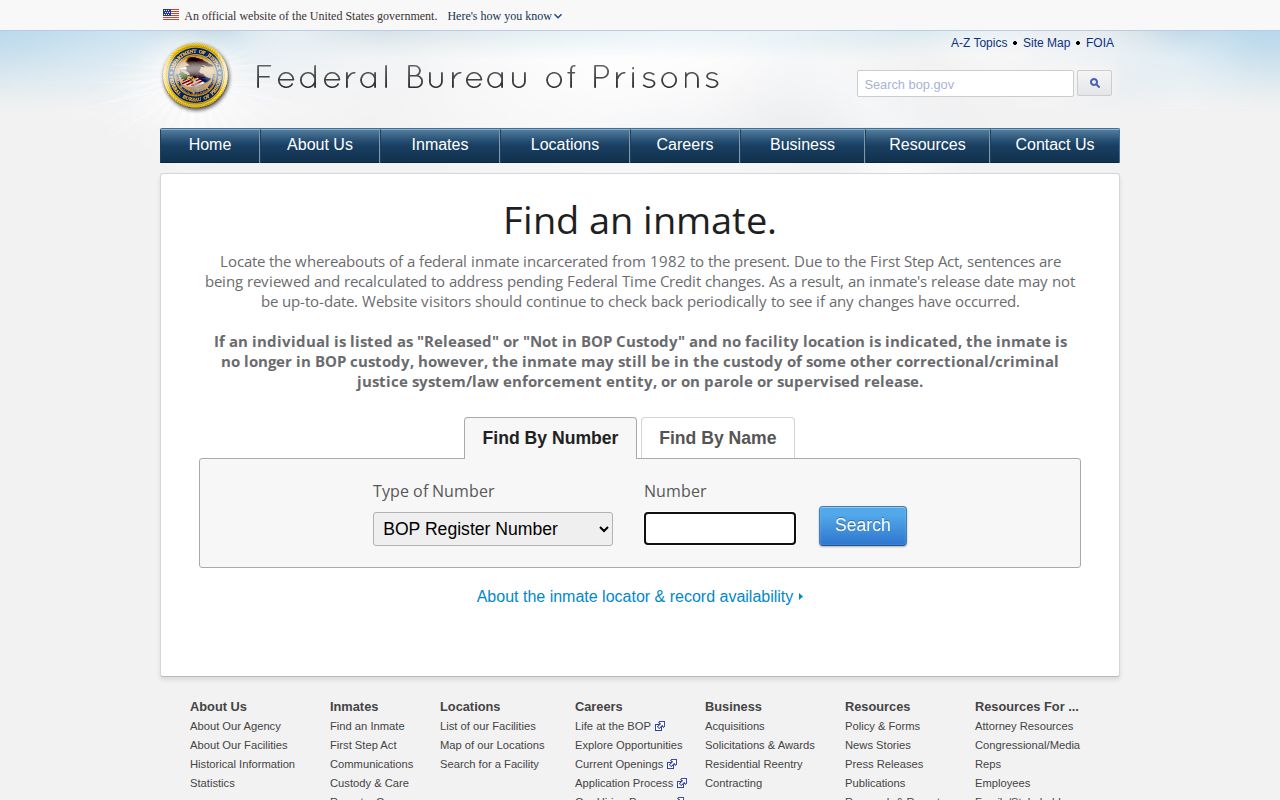
The captured locator is the proper federal prison search path. It is not the route for a Fentress County misdemeanor stay, a TDOC prison record, a person still solely in USMS pretrial custody, or an ICE civil detention event.
| Search input | Best use |
|---|---|
| BOP register number | Direct match to the federal prison identity |
| DCDC, FBI, or INS number | Alternate known federal identifier |
| Name | Candidate search when no number is known |
| Age, race, and sex | Optional narrowing and identity comparison |
USMS Release Record Limits
USMS prisoner guidance describes federal custody from a court order through acquittal or conviction and delivery to BOP, but USMS has no public released-prisoner locator. Because a marshal detainee may be housed in a county facility, the physical building and legal custodian can differ. Ask the Fentress jail for the receiving agency when a local episode ends, then use the federal court docket and USMS record channels.
A signed court order is authoritative about the judicial action, but it may precede processing or another hold. The agency custody record is stronger evidence of the physical handoff. When a releasable USMS record is needed, use the USMS FOIA information and describe the existing record narrowly. Do not ask the county to create a federal release history it does not maintain.
A narrow request can identify the person, federal case, approximate custody dates, and the sought transfer or release transaction. Ask for an existing record rather than a new narrative. If BOP later receives the person, its register number and admission information can corroborate the marshal transfer. If the court orders release but contact is delayed, another hold or processing step must be checked before the order date is treated as the physical release time.
Note: A local jail address never changes which federal agency legally controlled the prisoner.
Federal Release Contact Routes
The BOP locator is the primary public route for post-1982 federal prison custody. BOP’s own records and the federal court docket provide deeper proof. No local BOP institution contact can be listed for Fentress because no institution was identified in the county. The current location on a matched BOP result should guide any institution-specific inquiry.
Federal Bureau of Prisons SystemNationwide federal prison locator
Search: www.bop.gov/inmateloc/
Coverage: federal inmates from 1982 forward
No BOP institution identified in Fentress County
When the person was only in the Fentress County Jail, ask the sheriff for the local booking and release transaction. When the record says TDOC, switch to FOIL. The Fentress County release search describes that full custody-matched sequence.
A complete inquiry preserves the agency name, search URL, retrieval date, identifier, exact status, and exact date label. If a result conflicts with a court order or county transfer record, contact the agency that physically held the person and keep the conflict visible until corrected. Do not choose one result merely because it is newer or easier to access. Dynamic locators are useful summaries. Certified agency records and court orders provide the more durable trail.
ICE After Federal Release
A person may be transferred to ICE at the end of BOP or USMS custody rather than return to the community. ICE’s Online Detainee Locator includes current detainees and persons released from ICE custody within the last 60 days. After that period, absence from ODLS proves nothing about the older event. Exact name, country of birth, birth date, and A-number formatting can also affect results.
Keep the two events separate. A BOP release date proves the end of BOP custody. The ICE record then shows whether civil immigration custody followed and, for a limited period, whether ICE later released the person. USMS has no comparable public released-prisoner locator. Federal court and agency records fill that gap.
If ODLS produces no match, first check the A-number format, exact name, birth details, and country of birth. The locator excludes minors and may not show a person during recent processing. After the released-person window expires, a failed result has even less historical value. The ICE information line and immigration case channel can address that separate federal stage, while the BOP result remains proof only of the prison-system departure.
A state detainer can create another branch. When the federal record or docket identifies a Tennessee hold, compare the federal release date with FOIL and the receiving state or county admission. The end of BOP custody may occur on the same day another agency takes control. Record both events and do not merge their status labels.
Public Record Search
Sponsored Results