
District 21 Release Supervision
TDOC District 21 Community Supervision is a field system, not a jail. Its Clinton office serves Fentress, Anderson, Morgan, and Scott Counties. A person whose FOIL record shows probation or parole is in the community under state supervision rather than in a prison cell. That status does not establish that all sentence duties ended. It identifies a post-release or court-ordered supervision path.
Tennessee separates decisions from field work. The Tennessee Board of Parole conducts hearings and decides parole matters. TDOC calculates release eligibility and manages probation and parole supervision in the field. A person released on bond or after a completed misdemeanor sentence may have no TDOC status at all. County court records remain the better source for those local outcomes.
| Status | What it means | Primary confirmation |
|---|---|---|
| Parole | Conditional release before sentence expiration after Board action | FOIL, Board record, and District 21 |
| Probation | Court-ordered community sentence, sometimes after confinement | Judgment, FOIL when state-managed, and field office |
| Inactive | Active TDOC custody or supervision may have ended | Full FOIL detail and official discharge record |
| Incarcerated | Physical prison custody continues | FOIL location and TDOC |
Verify Fentress Supervision Records
Begin with TDOC FOIL. It covers current and former felony offenders in state custody or supervision. Search by TDOC ID or SID when available. A name search allows last and first name, race, and aliases, but a name alone may match the wrong person. Open the record only after comparing identifiers and case facts.
A sound verification sequence is short:
- Search FOIL by a known ID or exact name and compare all possible matches.
- Read the exact status rather than treating any result as current custody.
- Review release and sentence information, keeping eligibility and actual release dates distinct.
- Call District 21 with the TDOC ID when current office confirmation is appropriate.
- Use the local judgment for court-imposed probation terms or a Board record for a parole decision.
District 21 Fentress Contact
The TDOC field office directory places Fentress County in District 21. The published office for Fentress, Anderson, Morgan, and Scott is in Clinton rather than Jamestown. Call before travel and follow the assigned officer’s reporting instructions. Public directory information does not establish a person’s private appointment schedule.
TDOC District 21 Community Supervision110 E. Centre Stage Business Park
Clinton, TN 37716
Phone: 865-220-4001
Fax: 865-463-7084
The official directory screenshot documents the regional coverage. Review the current directory entry because office assignments and contacts can change.
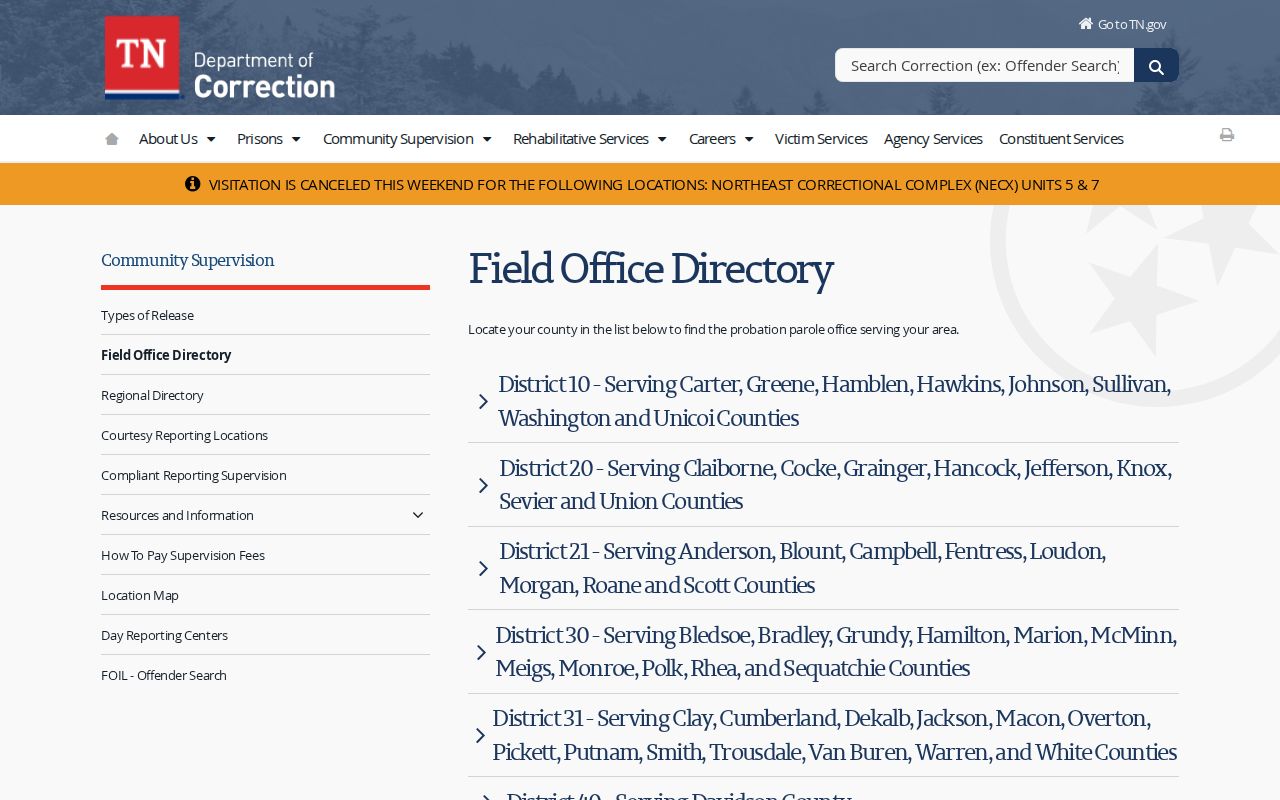
The captured page supports District 21’s role and regional office route. It does not disclose an individual’s supervision conditions or prove a current status without a matched offender record.
TDOC announced mobile community-supervision offices for rural areas in 2026, but the cited announcement did not publish a fixed Fentress schedule. A mobile initiative therefore should not be treated as a standing Jamestown office or a reason to skip the assigned officer’s instructions. Confirm where and when to report through District 21. The Clinton address remains the published regional contact for Fentress in the field-office directory.
Fentress Parole Decision Records
A parole hearing date or grant is not the same as a prison-door release. Hearing officers gather facts and make nonbinding recommendations. Board members may adopt, modify, or reject those recommendations. A grant can depend on concurring votes, an approved plan, and other conditions, and it can be rescinded before release. The release transaction must still be recorded by TDOC.
The Board’s hearing schedule page says prison and county-jail schedules are updated weekly on Monday, or Tuesday after a Monday holiday. Schedules are available by email request at BD.HearingSchedules@tn.gov and may change at the last minute. The Board’s main number is 615-741-1150. Ask for the Parole Hearings Division when confirming a schedule.
No current public statewide decision-results search was found in the research. An offender-specific final-decision notice or status can be sought through FOIL or a Board records request. The Board asks for a specific request and proof of Tennessee citizenship; fees may apply, and inspection is by appointment.
Board proceedings can include grant, preliminary or final revocation, custodial, rescission, time-setting, and appeal hearings. A final revocation hearing can revoke or reinstate supervision. A rescission proceeding may affect a grant before or after the planned parole event. Those labels must be kept with the correct date. If an appeal is contemplated, the final-decision notice matters because Tennessee law generally ties the request window to the offender’s receipt of that notice.
District 21 Release Categories
Parole is only one path. Probation is imposed by a court and may follow split confinement. Determinate release applies under statutory conditions to some one-to-two-year felony sentences; TDOC’s Types of Release page says a qualifying person must have served at least 30 percent, subject to the legal process and objections. Mandatory reentry supervision is another statutory category for specified sentences and offense dates.
Terms should remain exact because each one answers a different question. A court judgment is the source for probation. The Board record explains parole action. TDOC’s release record shows the state custody event, and FOIL gives the public status summary. District 21 verifies field-office service where an official current check is appropriate.
Supervision can also end in more than one way. Completion may lead to a formal discharge, while an alleged violation can produce a hearing, revocation, reinstatement, or a new custody event. A later jail booking does not explain the earlier status by itself. Preserve the dates and identifiers from both records. If FOIL changes from parole or probation to inactive, ask for the TDOC record that explains when active supervision ended. A local court satisfaction entry may answer a court-managed probation question, but it should not replace a TDOC discharge when the state agency managed the case.
- Parole
- Conditional community release before sentence expiration after Board action.
- Probation
- A community sentence ordered by a court.
- Determinate release
- A statutory supervised-release path for certain shorter felony sentences.
- Discharge
- The recorded end of the applicable supervision or custody obligation.
Fentress Warrants and Absconders
No public Fentress County absconder list was located. The Sheriff’s FAQ states that warrant, summons, and civil-paper information is not provided by telephone and describes an in-person process for someone asking about their own status. A refused phone answer cannot be used to infer that no warrant or supervision issue exists. This is a key local limit on status checks.
An absconder is a person alleged to have stopped reporting or otherwise left supervision without authorization. A violation can lead to a warrant, hearing, revocation, or reinstatement, depending on the process. Confirm state supervision issues with TDOC or the Board and court matters with the proper clerk. Lack of contact with the person is not a record of violation.
Keep an alleged supervision violation separate from a confirmed revocation. A warrant can authorize action without proving the final result. A final Board hearing may revoke or reinstate parole, while a court handles the probation process assigned to it. FOIL can provide a current public lead, but the decision notice, court order, and later custody transaction document what actually changed.
Note: Fentress jail staff, court staff, TDOC, and the Board each hold different parts of a post-release record.
Federal Handoffs From Supervision
When a state-supervised person enters another custodian’s control, a county or TDOC release to ICE or USMS is not proof of return to the community. ICE’s locator includes released-from-ICE records for only 60 days, so later absence cannot establish freedom. USMS has no public released-prisoner locator.
When a federal hold or detainer appears in a state record, keep each event separate. FOIL and District 21 explain Tennessee custody or supervision. The receiving federal agency and court record explain what happened next. The broader Fentress County release-record search sets out the custody-matched chain without treating one system’s departure as the final outcome.
A new detention event may pause or alter community supervision without erasing the earlier release. Compare the TDOC number and state status with the receiving agency’s identifier and admission date. If FOIL still shows parole or probation while another locator shows custody, ask the responsible agencies to explain the overlap. Dynamic public records can update at different times, so the apparent conflict should remain documented until the custodians resolve it.
Public Record Search
Sponsored Results